If you work with powders—whether flour, milk powder, coffee, spices, pharmaceuticals, or chemical additives—you already know that filling accuracy is one of the hardest goals to achieve. Powders flow differently from liquids. They can be light and airy, dense and sticky, or prone to caking. A simple volumetric filler often struggles to maintain consistent weights, especially when product density changes from batch to batch.
That is exactly where the 1g-5000g table automatic auger power filling machine comes in. This compact, semi-automatic unit is designed to bring precision, flexibility, and hygiene to powder filling operations without requiring a large production line. But what can it actually do for you? Let's explore its capabilities in practical, day-to-day terms.
The 1g-5000g table automatic auger power filling machine is a compact, semi-automatic powder filling solution built for accurate dosing across a wide fill range. It combines an auger screw metering system with electronic weighing feedback to deliver consistent fill weights of approximately ≤±0.3% to ±1%, depending on the product and setup.
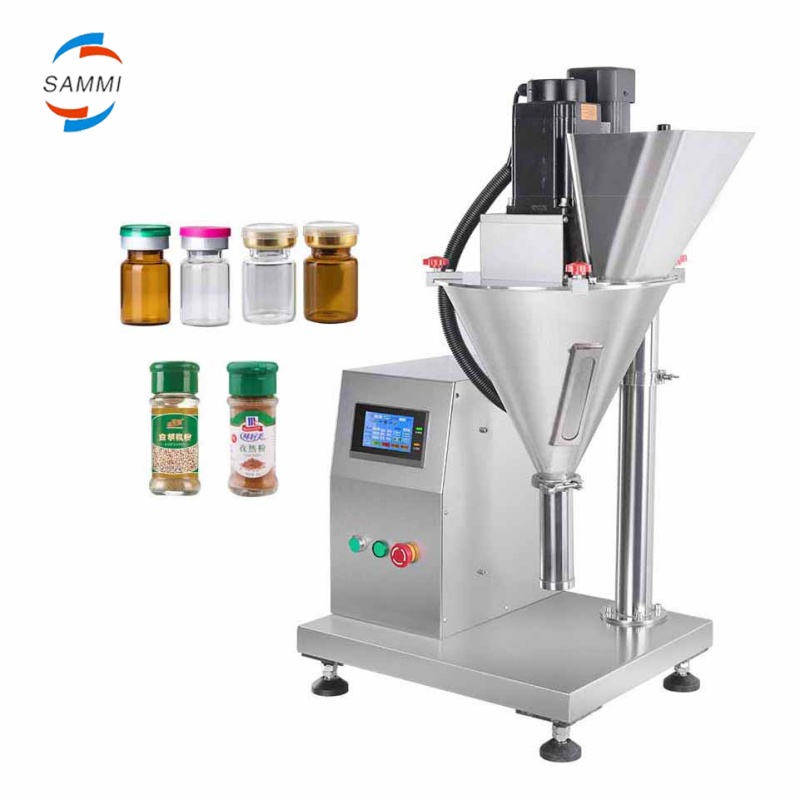
Designed as a tabletop workstation, the unit handles fill weights from 5g to 5000g, works with a broad variety of free-flowing, dusty, and sticky powders, and uses stainless steel for all material-contact parts to meet GMP hygiene standards. This article explains what the machine can do in practical terms—covering accuracy, powder compatibility, daily operation, hygiene, footprint, container formats, industry applications, and scalability.
The most obvious answer is also the most important: this machine fills powder accurately across an unusually wide range. With a 5g to 5000g fill range, you can use the same unit for small sample sachets, retail jars, bulk bags, and everything in between. The fill weight is adjusted electronically through the control panel, and the auger screw rotation is precisely controlled by the motor.
Because the system uses weighing feedback, it does not simply assume that a fixed number of auger turns will always produce the same weight. Instead, it tracks the actual fill weight and automatically compensates for changes in powder density, hopper level, and material flow. The result is filling accuracy of approximately ≤±0.3% to ±1%, depending on the product and setup. For many powder products, that level of consistency is difficult to achieve with basic volumetric filling equipment.
Not all powders behave the same way. Some are free-flowing, like sugar or salt. Others are fine and dusty, like starch or milk powder. Some are sticky or prone to bridging, like certain spice blends or chemical additives. The 1g-5000g table automatic auger power filling machine is built to handle this diversity.
By changing the auger screw attachment, you can adapt the machine to different powder characteristics and fill weights. The auger gently moves material from the hopper to the filling nozzle, reducing the risk of crushing or compacting delicate products. The openable, visibility-oriented hopper also allows operators to monitor material flow and intervene quickly if bridging or blockages occur.
This adaptability means you do not need a separate machine for every powder type. You can switch between products with a reasonable changeover procedure, making the equipment suitable for contract packers, specialty food producers, and pharmaceutical workshops that handle multiple formulations.
The machine is designed for semi-automatic operation. The filling cycle itself follows a simple, repeatable sequence:
This hands-free triggering reduces operator fatigue and helps maintain consistent cycle timing. Because the controls are electronic and the fill weight is set via a keyboard interface, operators do not need to manually adjust mechanical parts for every product change. Once the correct parameters are entered, the machine manages the filling cycle. This makes training easier and reduces the chance of human error during routine production.
For businesses that are moving from manual scooping or basic volumetric filling, this level of automation can significantly improve workflow without requiring a fully automated inline system.
Hygiene is a non-negotiable requirement in food, pharmaceutical, and many chemical applications. The 1g-5000g table automatic auger power filling machine uses stainless steel for all material-contact parts, meeting GMP hygiene standards. This construction helps prevent corrosion, resists powder buildup, and makes cleaning more effective.
The hopper and auger assembly are designed for accessibility. Components can be removed for cleaning without specialized tools, and smooth internal surfaces reduce the areas where powder can accumulate.
Regular cleaning also helps maintain filling accuracy. Powder residue on the auger or nozzle can affect flow characteristics and lead to weight drift. By making cleaning straightforward, the machine encourages better maintenance habits and more reliable long-term performance.
For facilities that need to prevent cross-contamination between allergens, colors, or active ingredients, this cleanability is a major operational advantage.
Not every manufacturer has room for a large, multi-lane filling line. The tabletop design of this auger filler makes it suitable for workshops, small factories, laboratories, and pilot production areas. Its dimensions are compact, and it can be placed on a sturdy workbench or small production table.
Despite its small footprint, the machine does not sacrifice capability. It can fill up to 20–50 packs per minute, depending on fill weight, powder characteristics, and operator speed. For many small and medium businesses, that throughput is more than enough to meet daily production targets while maintaining accuracy.
52 × 43 × 97 cm and 66 kg total weight, so it fits on a sturdy workbench or a small production table.
The machine can also be integrated with an auger feeding device controlled by sensors. This allows for continuous material supply and reduces the need for frequent manual hopper refilling, making it easier to run longer production sessions.
Inconsistent fill weights create problems throughout the packaging process. Underfilled containers may fail quality checks. Overfilled containers may create mess, sealing issues, or customer complaints. Both situations lead to rework, rejects, and wasted product.
The 1g-5000g table automatic auger power filling machine addresses this by maintaining tight control over each fill. The automatic error tracking and compensation system adjusts for material changes, so the machine continues to hit target weights even as conditions shift. This consistency helps you produce packages that meet specification more reliably, reducing the need for manual weight checks and corrective actions.
For products with strict regulatory or label requirements, this level of control is especially important. It helps ensure that every package contains the declared amount, supporting compliance and brand trust.
Because the filling nozzle is positioned over an open container, the machine can work with a wide range of packaging formats. You can fill rigid containers as well as flexible bags and pouches, provided they are held steady during filling. This flexibility makes the machine useful for both retail packaging and bulk industrial packaging.
The photoelectric switch can be adjusted to suit different container heights and positions. Operators can also use foot pedals or manual triggers in some configurations, depending on the production setup. This adaptability means the machine can grow with your product line rather than being locked into a single package type.
The applications for this machine are broad. Each industry has different requirements, but they share a common need: accurate, repeatable powder dosing. The 1g-5000g table automatic auger power filling machine provides that core capability in a format that is accessible, cleanable, and flexible.
Milk powder, coffee, flour, sugar, salt, starch, seasonings, and solid drink mixes.
Veterinary drugs, enzyme preparations, herbal powders, and protein supplements.
Plaster powder, additives, dyestuffs, and granular materials.
Fodder, premixes, and pesticide powders.
For growing businesses, one of the biggest challenges is scaling up without overcommitting to complex equipment. This tabletop auger filler offers a practical middle ground. It is more accurate and efficient than manual filling, but it does not require the integration work, floor space, or operator specialization of a fully automatic line.
As your production volume increases, you can add auxiliary equipment such as feeding systems, conveyors, or sealing machines. The core filling function remains reliable and consistent. This step-by-step approach allows you to improve your packaging operation at a pace that matches your actual production needs.
| Parameter | Specification |
|---|---|
| Model | SM-50S |
| Fill Weight Range | 5g – 5000g |
| Metering Mode | Auger rotation with weighing feedback |
| Filling Accuracy | ≤±0.3% – ±1% |
| Filling Rate | 20–50 packs/min |
| Power | 600W, 220V/50Hz/60Hz |
| Hopper Volume | 8L |
| Total Weight | 66 kg |
| Dimensions | 52 × 43 × 97 cm |
The 1g-5000g table automatic auger power filling machine is a strong fit for:
It may not be the right choice for operations that require fully automatic filling at very high speeds or continuous 24/7 operation without operator involvement. In those cases, a larger inline auger system would be more suitable. But for many businesses, this tabletop machine offers the right combination of precision, hygiene, and adaptability.
This machine can give you consistent fill weights across a wide range, handle different powder types, simplify daily operation, support hygienic production, fit into compact spaces, and adapt to changing packaging needs. It is not just a filling machine—it is a practical tool for improving powder packaging quality and reliability.
To learn more about the Model SM-50S, review full specifications, or discuss your specific powder application, visit the product page here:
Explore full specifications for the Model SM-50S, or reach out to our team to discuss your specific powder application and production requirements.
The machine covers a 5g to 5000g fill range. By changing the auger screw attachment and adjusting the electronic keyboard settings, you can switch between small sample sachets and larger containers on the same unit.
Filling accuracy is approximately ≤±0.3% to ±1%, depending on the product and setup. The system uses weighing feedback to track the actual fill weight and automatically compensates for changes in powder density, hopper level, and material flow.
It handles a wide variety of powders, including free-flowing materials like sugar and salt, fine and dusty powders like starch and milk powder, and sticky or bridging-prone products such as certain spice blends and chemical additives. Applications span food and beverage, pharmaceutical and nutraceutical, chemical and industrial, and agricultural products.
It is designed for semi-automatic operation. An operator places the container under the filling nozzle and triggers the photoelectric switch; the machine then dispenses the pre-set dose automatically. This hands-free triggering reduces operator fatigue and helps maintain consistent cycle timing.
No. All material-contact parts are made of stainless steel to meet GMP hygiene standards, and the auger screw and nozzle components can be removed without specialized tools. The hopper features an openable, visibility-oriented structure so operators can inspect and access internal surfaces easily.
Because the filling nozzle is positioned over an open container, the machine can fill rigid containers such as jars, cans, and bottles, as well as flexible bags and pouches held steady during filling. The photoelectric switch can be adjusted to suit different container heights and positions.
It is not intended for continuous 24/7 operation without operator involvement, or for fully automatic filling at very high speeds. In those cases, a larger inline auger system would be more suitable. However, the machine can be integrated with an auger feeding device controlled by sensors to support continuous material supply and longer production sessions.